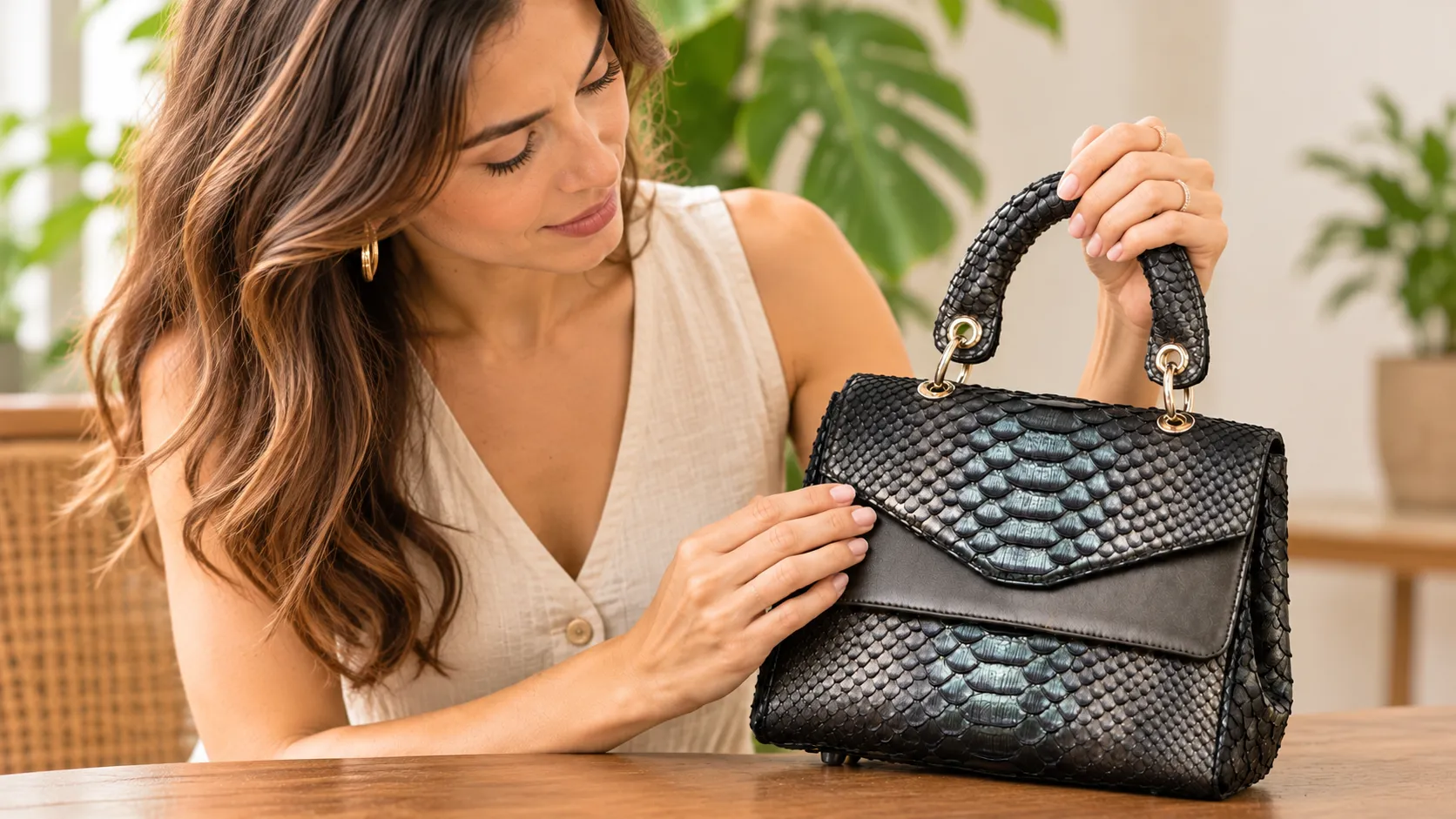
Check four places on the bag: the lining, the underside and inside seams, the scale pattern where one panel meets the next, and the cut edges. Real snakeskin varies from panel to panel, while copies tend to repeat.
Edges and seams show whether the base is leather or coated fabric. No one check proves it.
A photo shows a bag from its best angle, and you cannot pick it up through a screen. A bag does give you more to inspect than a belt or a wallet, though.
It has panels, seams, an inside and a base, and a copy has to get all of them right. The general tests are in our guide on how to tell real python leather from fake.
This page covers bags only.
What should you check inside a snakeskin bag?
Open the bag fully and look at the lining first. Fabric, leather and suede linings are all normal in a bag with real snakeskin outside, so the lining tells you how the bag was built, not what the outside is made of.
Look for neat cutting and even stitching.
Then go to the top opening, where the outer skin folds inward. Look at the back of that fold.
Leather shows a matte, soft or fibrous reverse. A copy often shows a fabric weave or a smooth film instead.
How does the scale pattern run across the panels?
Every snake grew its own scales, and their size and shape change from one area of the skin to another. So panels cut from real skin look related but not identical.
Embossed or printed material can repeat the same pattern, and that repeat is what you are hunting for.
- Front and back panels that carry the same pattern in the same place, like a stamp.
- A block of pattern that appears twice within one panel.
- Scales that barely change in size anywhere on the bag.
Visible joins are not a warning sign. Skins are narrow, so larger bags are often pieced from several strips.
Compare the strips on either side of a join. The scales should look natural on both, not copied from one to the other.
| What to look at | Real snakeskin tends to | Embossed or printed tends to |
|---|---|---|
| Front and back panels | Similar, not identical | Same pattern, same place |
| Scale size across the bag | Changes from area to area | Stays even |
| Pattern within one panel | No repeating block | A block can come round again |
| Back of the fold at the top opening | Matte, soft or fibrous | Fabric weave or smooth film |
What do the edges and hardware tell you?
Look at an exposed edge, such as the end of a strap or the base trim. Leather shows a fibrous cut edge.
Coated fabric shows a weave under a plastic layer. One limit: cowhide shows fibre too, so edges separate leather from synthetic, not snakeskin from embossed cowhide.
Paint on an edge can hide this, so check where it has rubbed or cracked.
Hardware is the weakest clue. A zip that runs smoothly and a clasp that closes cleanly point to a careful maker.
But a copy can carry good hardware, and real skin can carry poor hardware. It tells you about the build, not the skin.
Which photos should you ask for?
- The inside of the bag, open, in daylight, showing lining and seams.
- The back of the fold at the top opening.
- The base and underside.
- A close-up of one seam where two strips meet.
- The front and back side by side, in the same light.
- An exposed edge, such as the end of a strap.
Ask for photos of the actual bag, not a catalogue picture. A seller who has it in hand can send these.
If the terms on a listing are new to you, what python leather is explains them. If you are still choosing a material, read python skin bags compared with cowhide.
No check is proof, and that includes ours. Browse our snakeskin bags, then ask us for close-up photos of any bag in our shop.
Frequently Asked Questions
Does a fabric lining mean the bag is fake?
No. Real snakeskin bags are lined in all sorts of materials.
The lining shows how the bag was built. To judge the skin, look at the pattern and the back of the fold at the top opening.
Can a bag be part snakeskin?
Yes. Panels may be snakeskin while the straps or base trim are another leather.
That is fine when the listing says which part is which. If it does not, ask.
Can I judge a bag from one front photo?
Rarely. The inside, the base and the seams tell you more, so ask for those.
What if the seller only has catalogue photos?
Then you cannot run these checks, and that is worth weighing before you pay. Photos of the actual bag are the only way to inspect it from a distance.